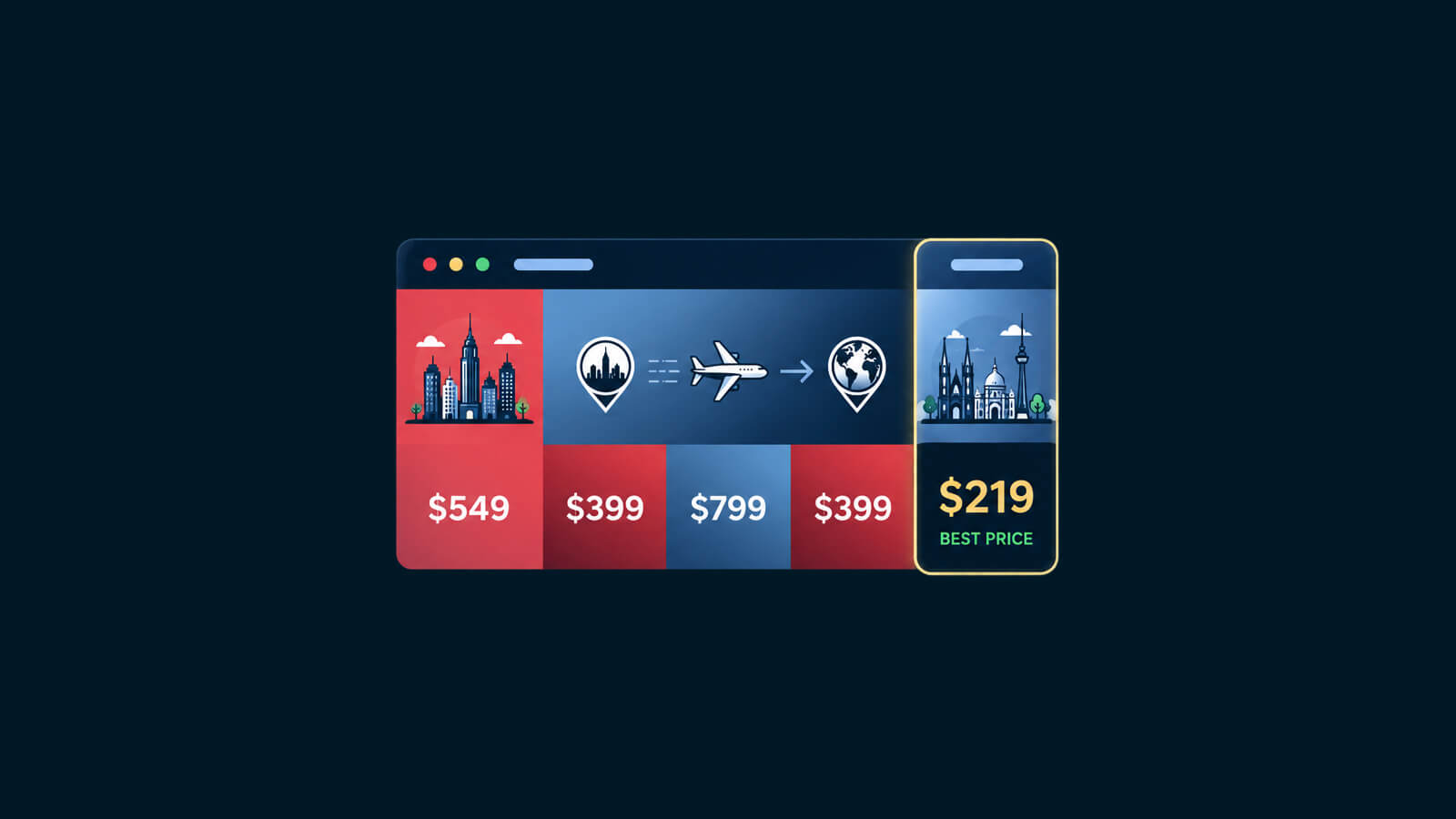
Airline: $450 for you. Same flight, same date, same seat: $280 for your friend.
This reflects real regional pricing variations. Airlines charge different prices in different markets based on location, currency, and local demand. Understanding how this works can help you find better fares—and VPN is one tool worth understanding that some travelers use to explore these variations.
How Airlines Set Prices by Location
Airlines don't charge everyone the same price. They use sophisticated algorithms to determine what you specifically will pay based on where you are.
Location-based pricing: Airlines check your IP address to identify your country and sometimes your city. Users from wealthy nations typically see higher prices than users from developing countries booking the same flight. A flight from New York to London might cost $580 for someone in the US, but only $420 for someone browsing from India—even if they're traveling the same route.
Why location matters: Airlines maximize revenue by charging what the market will bear. Wealthy countries have higher purchasing power, so airlines charge more. It's not illegal, but it's effective.
Real example: A traveler from the US sees $520 for a transatlantic flight. The same flight, viewed from the UK, displays at $380. Currency differences play a role, but the markup is deliberate.
Currency arbitrage: Some countries have weaker currencies. Airlines exploit this by charging less in those markets, knowing the absolute dollar amount is still profitable. But travelers outside those regions can take advantage by appearing to browse from them.
Flight Price Discrimination Explained
Flight pricing is dynamic. Airlines adjust prices in real-time based on demand, competition, inventory, and who's booking. But some of their tactics cross into discrimination.
Device-based pricing claims: While widely reported, evidence that airlines deliberately charge more on mobile devices is limited and debated. Airlines may show different prices based on supply/demand and booking patterns, but device type alone is unlikely a primary pricing factor.
Browsing history tracking: Airlines track some browsing behavior through cookies. Price increases after repeated searches may reflect rising demand for that route or the airline's yield management, not solely personalized pricing targeting you specifically.
Return customer penalties: Repeat visitors to airline websites sometimes see higher prices than first-time browsers. Airlines may use this information, knowing you've already done research and are more likely to commit rather than compare prices elsewhere.
Membership status: If you're logged into a frequent flyer account, airlines know your travel history and loyalty. High-value customers sometimes get premium pricing (paying more) while budget travelers get discounts.
Incognito browsing helps: Clearing cookies or using private browsing removes price-tracking history, sometimes revealing lower fares. But VPN takes this further.
Anecdotal reports from travelers suggest some price variation when using VPN and clearing cookies, though savings are inconsistent and depend heavily on route, season, and airline. Airlines continuously adapt their pricing algorithms.
How VPN Helps With Flight Prices
A VPN masks your real location, making it appear you're browsing from a different country. This may reveal regional price variations, though results are inconsistent and come with legal/policy risks.
Masking your location: When you use VPN, airlines see the VPN server's location instead of your real location. This may reveal regional price variations, though many airlines now detect VPN usage and don't show region-specific pricing to VPN users.
Example: A US traveler connects to a VPN server in Mexico, then searches for flights. Airlines see the Mexican IP address and may show prices optimized for the Mexican market—significantly cheaper than US-based pricing for the same routes.
Resetting price tracking: Using VPN alongside clearing cookies gives you a fresh slate. Airlines can't track your browsing history, so they can't inflate prices based on your previous searches.
Hiding your identity: Without your real IP address, airlines have less data to profile you. They can't correlate your browsing with your frequent flyer account or past purchases as easily.
Real limitations: VPN doesn't guarantee savings. Price differences vary significantly by route, airline, season, and timing. Many airlines show little regional pricing variation. Peak season routes typically show minimal regional price differences because demand is high globally.
VPN helps you find the lowest market prices, but airlines are cracking down on VPN-based bookings. Some require you to pay from a card registered in the country you're "browsing from." Always verify payment method requirements before completing a booking.
Step-by-Step Booking Guide
Here's how to use VPN strategically to find cheaper flights.
- 1Clear Your Browsing Data — Close all browser tabs, clear cookies, cache, and browsing history. Consider using an incognito/private window.
- 2Connect to VPN — Choose a VPN server in a country with lower purchasing power (India, Mexico, Turkey often show cheaper fares). Verify connection is working.
- 3Search Flights Directly — Go directly to airline websites (not search engines like Google Flights, which may show unified pricing). Some airlines offer better prices on their own site.
- 4Note Prices — Record the prices shown with VPN active. Don't open the price in a new tab or refresh excessively—airlines track repeated searches.
- 5Try Multiple VPN Locations — Disconnect and try a different VPN server in another affordable market. Compare prices across 2-3 different countries.
- 6Book via Payment Method — If you found the best price, note the booking details. You may need a payment card from that country, or airlines may require your billing address to match.
Good to Know: If exploring regional pricing with VPN, use private/incognito browsing between searches and consider booking from your home payment region to reduce payment-processing friction.
Travel Hacking Strategies
Beyond VPN, several tactics combine to maximize flight savings.
Flexible travel dates: Prices vary wildly by day of week. Tuesday and Wednesday flights are typically cheaper than Friday-Sunday flights. Off-season travel (shoulder months like May, September, October) shows dramatically lower fares.
Set price alerts: Use Google Flights, Hopper, or Kayak to set alerts for your route. You'll be notified when prices drop, letting you book at the optimal moment.
Book midweek: Tuesday through Thursday bookings often reveal the cheapest fares. Many airlines release sales Tuesday evenings, and competitors follow Wednesday-Thursday.
Use flight search aggregators carefully: Google Flights, Skyscanner, and Kayak generally display global pricing normalized across regions—they're designed to prevent the location-based discrimination found on airline websites. For regional pricing variation, check airline websites directly.
Airline sales and flash deals: Sign up for airline newsletters and follow them on social media. Many run flash sales (24-48 hours) with significant discounts on specific routes.
Incognito + VPN + clearing cookies = maximum impact: Combine all three for the best results. This removes all tracking data and masks your location simultaneously.
Consider nearby airports: Flying from a different city often saves money. Los Angeles to London might be cheaper from San Francisco or San Diego due to different market competition.
Safety & Legal Considerations
Using VPN for flight searches is legal, but there are important caveats.
VPN is legal: Using a VPN to browse the web is not illegal in most countries. VPN is widely used for legitimate privacy purposes.
Airlines' terms of service: Some airlines prohibit booking through VPN in their terms of service. While enforcement is rare, it technically violates their policies. They can cancel bookings if they discover VPN use.
Payment method matching: The bigger risk is payment issues. Many airlines require your payment card address to match your booking address. If you book from a "Mexican IP" but pay with a US card, payment may be declined.
Regional pricing and fraud: Airlines differentiate prices by region legitimately. Using VPN to access cheaper regional pricing is a gray area—it's not fraud (you're paying for a legitimate flight), but airlines view it as circumventing their pricing strategy.
The ethical reality: Using VPN to book flights from a different region technically violates most airlines' terms of service. Airlines actively work to prevent this, and can cancel bookings they identify as VPN-originated. If you choose to use VPN for flight searches, understand you're accepting this risk—it's not penalty-free.
Safer approach: Focus on legitimate flight-saving tactics (flexible dates, off-season travel, price alerts, comparing airlines). These typically save more money than VPN without the terms-of-service and payment-processing risks.
Real Examples & Typical Savings
Here are realistic examples of savings discovered through VPN and smart booking.
Example 1: Regional Price Variation (Best-Case)
- Same transatlantic route searched from US, UK, and Turkey
- Price differences exist: US ~$520, UK ~$445, Turkey ~$380
- This variation is real, but savings for individual travelers are inconsistent
- Note: This represents best-case scenario, not typical results
Example 2: Price Differences by Region
- Airlines maintain different regional pricing strategies
- Currency differences and local demand drive variations
- Your actual savings depend on route, timing, and airline policy
Realistic expectations: Price variations of 10-25% are possible on some routes, but many flights show minimal regional variation. Peak season and popular routes typically show less difference. Budget airlines often maintain consistent global pricing.
Important: These are illustrative examples, not guarantees. Results vary widely based on route, airline, season, and timing.
Limitations & Realistic Expectations
VPN isn't a magic solution for free flights. Understanding its limitations helps set realistic expectations.
Savings vary by route: High-demand routes (New York-London, Los Angeles-Tokyo) show more dramatic savings. Budget routes or underutilized flights show minimal differences.
Seasonal impact: Peak season (summer, holidays) pricing is high across all markets, limiting savings. Off-season travel shows better relative discounts but starts from lower base prices anyway.
Airline variation: Some full-service international carriers employ more aggressive location-based pricing strategies. Budget carriers typically maintain more consistent pricing across regions—VPN provides minimal benefit for budget airline bookings.
Currency fluctuations: When currencies fluctuate, regional pricing adjusts. A cheap price today might disappear tomorrow if exchange rates shift.
Airlines fighting back: Major carriers are implementing VPN detection and restrictions. Some require you to pay from a card registered in the browsing region. Others monitor IP patterns and flag suspicious bookings.
Not a replacement for legitimate tactics: VPN is one tool among many. Flexible dates, off-season travel, and price alerts often provide better savings without legal/policy gray areas.
The best savings come from: Flexible travel dates (biggest factor), traveling off-season, booking in advance, and comparing multiple airlines/routes.
VPN + incognito browsing + flexible dates is the most powerful combination. But if you can only choose one, flexible travel dates save more money than VPN. A Wednesday flight in May beats a Friday flight in July every time, regardless of VPN.
Frequently Asked Questions
Disclosure: This is promotional content from a VPN provider. We have financial incentive to encourage VPN use. However, we're committed to being honest about legal and ethical risks. The answers below acknowledge that using VPN for airline bookings violates terms of service and carries real risks. We recommend focusing on legitimate flight-saving tactics instead.
Searching flights with VPN is legal. Booking flights through VPN is not technically illegal in most countries, but it clearly and explicitly violates airline terms of service. This is a contractual violation, not a legal crime. However, airlines treat this seriously: they detect it, they cancel bookings, and enforcement is increasing. You're not breaking the law, but you are breaking the airline's rules knowingly.
Some airlines monitor for VPN use. If detected during booking, payment may be declined. If detected after booking (rare), your reservation could be canceled. It's a real but uncommon risk.
India, Mexico, Turkey, Philippines, and several Eastern European countries typically show the lowest fares due to lower purchasing power. Results vary by route and airline.
Price variations between regions exist (sometimes 10-25%), but individual savings are inconsistent. Many routes and airlines show minimal regional variation. Legitimate tactics like flexible dates and off-season booking typically produce more reliable savings.
Discount airlines (Southwest, Ryanair, EasyJet) often compete with VPN savings. Compare both. Sometimes a budget airline is cheaper overall despite VPN bookings looking lower on legacy carriers.
This is the safest approach IF you choose to use VPN for flight booking. However, understand clearly: using VPN to book flights from a different region than your payment card deliberately violates airline terms of service. Airlines explicitly prohibit this practice. While matching your VPN region to your card region reduces payment friction, you're still circumventing airline policies. Airlines actively detect and cancel such bookings. Know the risks before proceeding.
Rarely. Domestic flight pricing is less location-based and more demand/competition-based. VPN provides minimal benefit for flights within your country.
Some airlines require booking and billing addresses to match the browsing region. Do not provide false address information—this is fraud and is illegal. If you don't have a legitimate address in that region, don't book through VPN from that location. The legal and financial consequences of fraudulent booking information far outweigh any flight savings.
Airline websites often show lower regional prices than aggregators like Google Flights. Book directly when possible for maximum savings. Aggregators show unified global pricing.
Yes, but choose a reliable VPN with servers in multiple countries. Free VPNs vary widely in quality. Reputable free VPNs like VPN UK prioritize privacy and security, but lesser-known free VPNs may have data concerns. Choose established, trusted providers with transparent privacy policies.
Midweek (Tuesday-Thursday) typically shows cheaper fares. Search during off-hours (early morning, late night) to avoid peak browsing traffic. Fares change 24+ times daily.