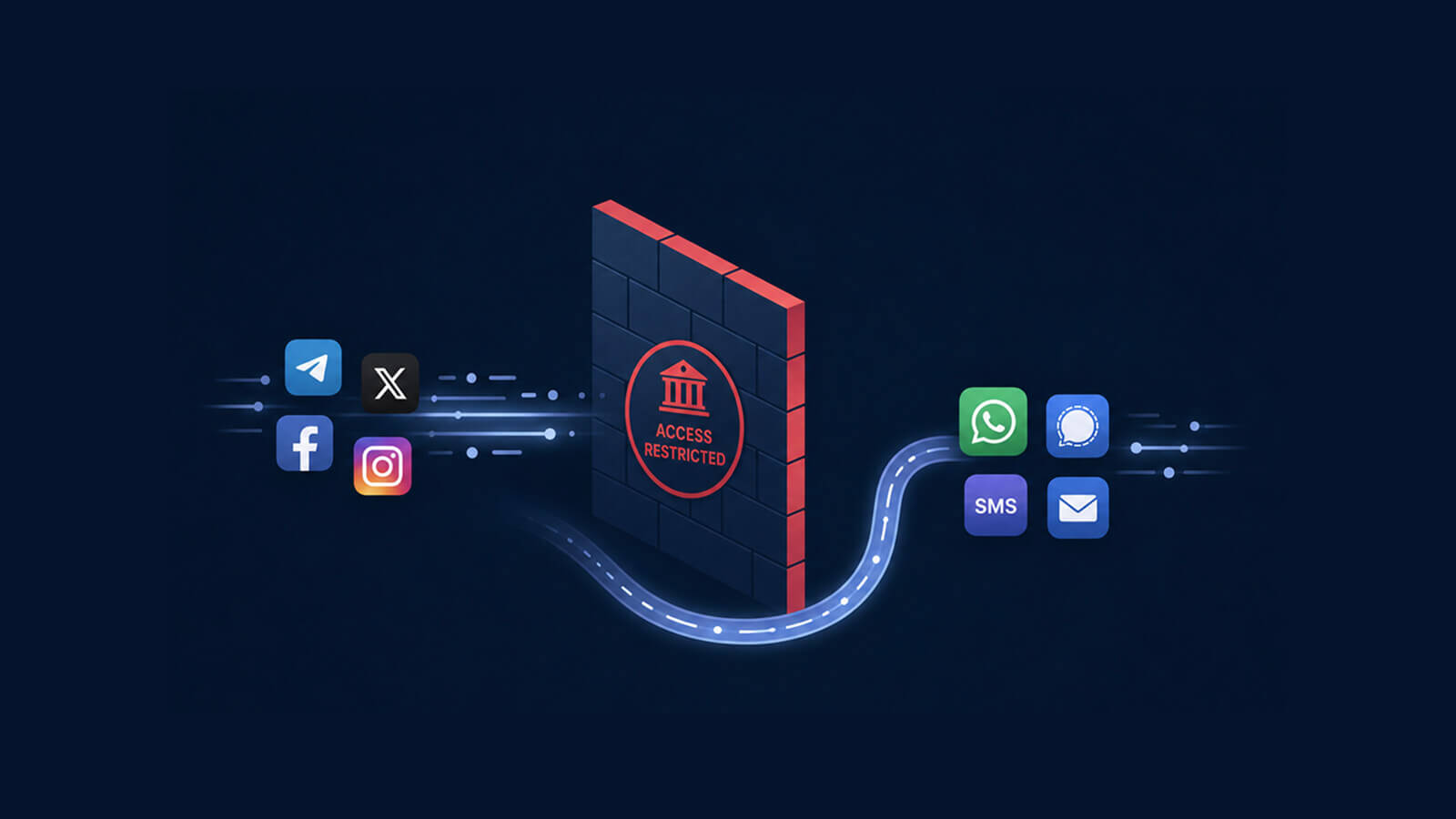
The Global Pattern: Apps Getting Blocked Worldwide
On June 17, 2026, India joined a growing list of countries blocking major communication apps. The Indian government shut down Telegram for all 150+ million users, citing exam fraud concerns. It's a temporary ban—lasting until June 22—but it reveals a global trend: governments increasingly use app bans as a tool to control digital communication.
India isn't alone. Here's what's happened across the world:
- Russia banned Telegram in April 2018, citing encryption/national security concerns. The ban was lifted in June 2020, but Russia has renewed aggressive restrictions starting February 2026—actively throttling Telegram and planning a full block by April 2026. By early April 2026, access for non-VPN users dropped to just 5%.
- Iran periodically blocks Telegram and uses bandwidth throttling to restrict access
- Spain attempted a nationwide block in March 2024 after media companies complained about copyright infringement on the platform (order was suspended 3 days later pending legal review)
- Norway recommended in 2023 that government officials remove Telegram from work devices for national security reasons; separately, a proposed bill being discussed for 2026 would restrict social media access for children under 16
- Germany pressured Telegram to remove extremist content, threatening regulatory action
So why are democracies and authoritarian governments alike turning to app bans? And what can users do when their primary communication tool disappears overnight?
India's Telegram Ban: A Case Study
What Happened: On June 17, 2026, India's Ministry of Electronics and Information Technology issued a blocking order under Section 69A of the Information Technology Act, citing organized exam fraud linked to the NEET UG 2026 re-examination.
The Official Justification: The National Testing Agency reported that organized networks were coordinating via Telegram, sharing exam materials and using message-editing features to cover their tracks. The government deemed the ban necessary to protect exam integrity.
The Numbers: Over 150 million users lost access to Telegram overnight. The ban is set to last until June 22, 2026. Additionally, Telegram was ordered to disable message-editing features until June 30.
The Debate: Telegram founder Pavel Durov called the action collective punishment, arguing that banning an entire app to stop a subset of bad actors harms millions of legitimate users. The Indian government countered that the measure was a "last resort" when other options failed.
When governments block apps, entire populations lose access to services they depend on for work, education, and personal connection—affecting far more people than those actually engaged in the problematic behavior.
The Real-World Impact of App Bans
When a government blocks an app, the consequences ripple through daily life:
Immediate Disruption
- Business teams lose communication channels during critical work periods
- Students studying remotely can't access group chats and educational resources
- People relying on the app for family coordination face sudden disconnection
- Support networks go offline with no warning
Broader Questions
App bans raise important governance questions:
- If an app can be blocked for one reason (exam fraud, in India's case), what prevents future blocks for other reasons?
- Who decides what justification is sufficient for a country-wide ban?
- How much due process should be required before millions lose access to a service?
- What happens to user data already stored on these platforms?
The Pattern Across Countries
Each nation frames app bans differently: India cites exam integrity, Russia emphasizes terrorism concerns, Iran focuses on national security, and European nations cite data protection. Despite different stated reasons, the outcome is consistent: users lose access to communication tools they depend on.
Why App Bans Are Becoming Common
While stated reasons differ, governments increasingly view app restrictions as a legitimate tool. This has created a cascade effect: once one country bans an app, others feel justified in doing the same.
For Users, This Means:
- Apps you depend on can disappear with little notice
- Governments rarely ask for public input before implementing bans
- The process is often legally justified under broad national security or public order laws
- "Temporary" bans can become permanent or lead to partial restrictions
Privacy & Security When Apps Are Blocked
Often, the "safer" alternatives users migrate to are actually less secure than the original app. A ban can push users toward choices they wouldn't normally make, potentially reducing overall privacy.
When apps are blocked, what happens to user data already stored on servers varies significantly. Some countries require apps to delete user data, others leave it in place but block access, and some demand data handover to authorities. This uncertainty makes app bans a privacy risk.
How VPNs Restore Access When Apps Are Blocked
How a VPN Works
When a government blocks an app in a specific country, it typically does so at the ISP (Internet Service Provider) level. The ISP detects traffic to the app's servers and blocks the connection.
A VPN (Virtual Private Network) bypasses this by:
- 1Encrypting your traffic — Your ISP can't see where you're connecting
- 2Routing through another country — Your connection appears to come from outside the blocked region
- 3Masking your location — The blocked app's servers don't detect you're in a restricted country
- 4Re-establishing access — You can use the app normally
Why This Works
Most countries block apps at the network infrastructure level, not by blocking individual devices. A VPN makes your traffic appear to originate from elsewhere, circumventing infrastructure-level blocks.
Choose a VPN with strong privacy practices: no-logs policy, multiple server locations, reliable performance, and support for the platforms you use. Avoid VPNs with servers in countries with strict data retention laws.
VPN Legality Across Different Countries
The Legal Status Varies Significantly
VPN legality depends entirely on where you are. In most democracies, VPNs are openly available and widely used. In India, VPNs are legal to use, though providers must store data locally (CERT-In rules). In Russia, VPNs are technically legal but blocked by ISPs. In China, only government-approved VPNs are permitted. In Iran and the UAE, VPNs are restricted and heavily throttled.
What Matters for App Access
Even where VPNs are legal to use, governments vary in how they respond to VPN-based app access. Some countries tolerate VPN use for accessing blocked services, others actively work to block VPN connections, and a few pursue VPN users (though this is rare).
General Principle
Using a VPN to restore access to a blocked app sits in a legal gray area in most countries. You're not breaking VPN laws, but you're circumventing a government ban. Proceed with awareness of your local context and laws.
The Bigger Picture: Internet Fragmentation
What we're seeing globally is the emergence of fragmented internets—different regions with different available apps and services.
Why This Matters
- Loss of global connectivity — Apps that connect billions become unavailable in certain regions
- Precedent-setting — When one country successfully bans an app, others take notice and feel justified doing the same
- Digital divide — Wealthier users with knowledge of VPNs can restore access; others can't
- Business impact — Multinational companies can't rely on specific communication tools across all regions
- Innovation suppression — New apps face the threat of regional bans before they can gain global traction
The Trend
App bans are increasing, not decreasing. As governments become more comfortable using this tool, more bans are likely. This signals: reliance on a single app creates vulnerability, backup communication channels are increasingly important, and privacy tools like VPNs may be necessary, not optional.
Protecting Yourself When Apps Are Blocked
During an App Ban
- Use a VPN with strong privacy practices (no-logs, multiple server locations)
- Diversify communication channels — don't rely on a single app; maintain backups
- Choose secure alternatives — if switching apps, prioritize end-to-end encryption
- Protect sensitive data — don't send passwords, financial info, or personal data over unencrypted channels
- Monitor official sources — stay informed about when/if the ban is lifted
Long-Term Privacy Strategy
- Use encrypted messaging — adopt apps with strong end-to-end encryption by default
- Understand your VPN provider — read their privacy policy; know whether they log data
- Stay informed — follow organizations like the EFF, Access Now, and Amnesty International
- Use layered security — combine VPN + encrypted messaging + privacy-focused browsers
- Backup your data — store important communications and contacts outside apps
- Build redundancy — maintain access to multiple communication platforms
Frequently Asked Questions
Your questions about app bans and VPN access answered
Yes, in most cases. VPNs work by routing your traffic through servers outside the blocking region, making it appear you're accessing from elsewhere. Success depends on the VPN quality and whether the country actively blocks VPN connections.
This varies by country. VPNs themselves are legal in most democracies. Using a VPN to circumvent an app ban exists in a legal gray area—technically you're not breaking VPN laws, but you're bypassing a government ban. Research your local laws before proceeding.
Look for: (1) Strong encryption, (2) No-logs policy (data protection), (3) Multiple server locations, (4) Reliable performance, (5) Support for the platforms you use. Avoid VPNs with servers in countries with strict data retention laws.
Some do, but it's technically difficult. VPNs use encryption that's hard to distinguish from other secure traffic (like banking or online shopping). Blocking VPNs broadly would damage legitimate uses like corporate remote work and online banking.
It varies widely. India's Telegram ban is "temporary" until June 22, but some bans become permanent. Russia's Telegram ban lasted years before partial lifting. Assume temporary bans may become more permanent once governments normalize using this tool.
Depends on the country. Some require apps to delete user data; others leave it in place but block access. Most users assume their data remains accessible if/when the app returns. However, some governments demand data handover during bans.
It depends on your needs. Signal offers the strongest privacy (open source, E2E encrypted by default). WhatsApp is more popular and widely used. Maintain accounts on multiple platforms for redundancy.
VPN policies vary. Corporate and school networks often block VPN use for security reasons, regardless of app bans. Check your organization's policy before attempting VPN use on their networks.